PRIVATE DESIGN PREVIEW Product data and supply terms are being verified. RFQ lists stay in this browser.
Wenzhou Changsong Electric Co., Ltd.
Catalogs & technical filesContact & inquiryEN
CHSOINDUSTRIAL ELECTRICALRequest a quote 0→
End Caps

Copper Comb Busbar End Caps

CS-series insulating end caps for 1–4 pole comb busbars, including standard, E-profile and three-pole D-profile versions.

1–4 polesStandard / E / D13 article numbers
Copper Comb Busbar End Caps
CS End Caps · End Caps
Technical data

Product specifications

Match the pole count, conductor-section designation and housing profile together. Standard, E and D caps have different engagement shapes; an equal pole count does not make them interchangeable.

CS End Caps technical specifications
ParameterSpecification
Product typeInsulating busbar end cap
FunctionCovers the exposed end of a matching busbar profile
Pole options1P, 2P, 3P and 4P
Profile optionsStandard, E and 3P D
Section designations10 mm² / 16 mm²
ColourLight grey
Model selection

Ratings, contact patterns & dimensions

All dimensions are in millimetres unless stated otherwise. Conductor cross-section is in mm²; the model-table width is distinct from contact tooth width.

Section designations identify the corresponding busbar size, not a current rating of the end cap. Use the article number as the ordering reference.

CS busbar end-cap article numbers
Article numberProfilePolesBusbar section designation (mm²)
CS110Standard110
CS116Standard116
CS21016Standard210 / 16
CS31016Standard310 / 16
CS41016Standard410 / 16
CS11016EE profile110 / 16
CS210EE profile210
CS216EE profile216
CS310EE profile310
CS316EE profile316
CS410EE profile410
CS416EE profile416
CS310DD profile310
CS E-profile busbar end caps for 1–4 poles
CS3-10D three-pole busbar end cap
Application & installation

Fit the complete device row

Application fit

  • Closing matching comb busbar ends in distribution boards
  • Completing the insulation profile after an approved length preparation

Ordering checklist

Match the pole count, conductor-section designation and housing profile together. Standard, E and D caps have different engagement shapes; an equal pole count does not make them interchangeable.

Include quantities, destination and packaging requirements. For a replacement, identify the connected devices and the full contact sequence.
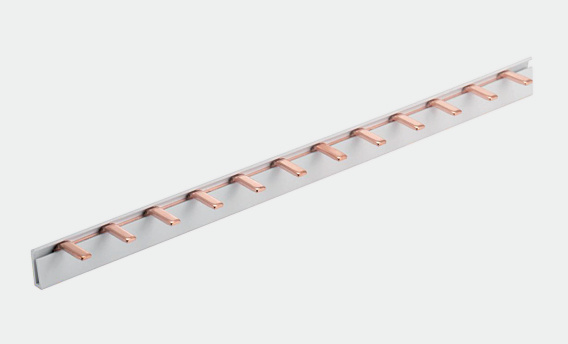
Installation sequence

  1. Isolate the supply and verify that the assembly is de-energised.
  2. Check the device lineup, phase and neutral sequence, contact positions and insulating profile.
  3. Use the specified finished length. Where the selected design permits cutting, remove swarf and burrs and refit matching end insulation.
  4. Seat contacts fully in the intended terminal openings and tighten to the connected device manufacturer’s specified torque.
  5. Protect unused exposed contacts, inspect end caps and verify continuity, separation of poles and conductor retention before energising.
Practical answers

Frequently asked questions

How is a busbar end cap selected?

Match the number of insulated copper paths, the busbar section designation and the physical housing profile. Use the article number in the table.

Does an end cap cover unused contact teeth?

No. An end cap closes the bar end; unused exposed contacts need a separately matched tooth cover or the protection required by the complete assembly.

Can the E profile replace a standard cap?

Only when its engagement shape matches the insulating profile. Pole count and colour alone do not establish fit.

Distributor & panel-builder inquiries

Specify the layout.
Get the right connection.

Include CS End Caps model and layout, required length or tooth count, matching device series, quantities and end-cap requirements.

Request pricing ↗